Inglés
 Español
The Pantheon in Rome and Sustainability at a 2,000-Year Horizon
The Pantheon in Rome and Sustainability at a 2,000-Year Horizon
There are buildings that belong to their time—and others that seem to have transcended it. The Pantheon in Rome clearly belongs to the latter. A space built nearly two thousand years ago in concrete. Yes, concrete. Yet held up by a column made of a material that cannot be touched.
Rome is a paradise for those who love architecture. The Colosseum, the Domus Aurea, San Carlino… and yet, among them stands a building many consider the finest ever constructed: the Pantheon. Not for its monumental scale or ornamentation, but because it is an absolute masterpiece of opus caementicium—Roman concrete. The current structure was built in the 2nd century AD under Emperor Hadrian, likely following a design attributed to Apollodorus of Damascus, on the remains of an earlier temple erected a century before by Marcus Vipsanius Agrippa. Hence its other name: the Pantheon of Agrippa. In a rare gesture, Hadrian chose to preserve the original inscription on the portico—M·AGRIPPA·L·F·COS·TERTIVM·FECIT—as a tribute to tradition, even though the building we see today is a later creation.
The original temple had proven structurally fragile. The response was to turn to a more reliable system already widely used in Rome: concrete. The result was a work that, two millennia later, remains one of the most admired, studied, and difficult-to-equal achievements in architectural history—not through excess, but through intelligence. Crossing the classical portico, the interior space reveals itself unexpectedly: a perfect circular chamber inscribed within an ideal sphere, where height and diameter coincide exactly. Nothing is arbitrary. The Pantheon is not just a building; it is a physical representation of cosmic order—an architecture conceived to relate human beings to time, matter, and the sky.
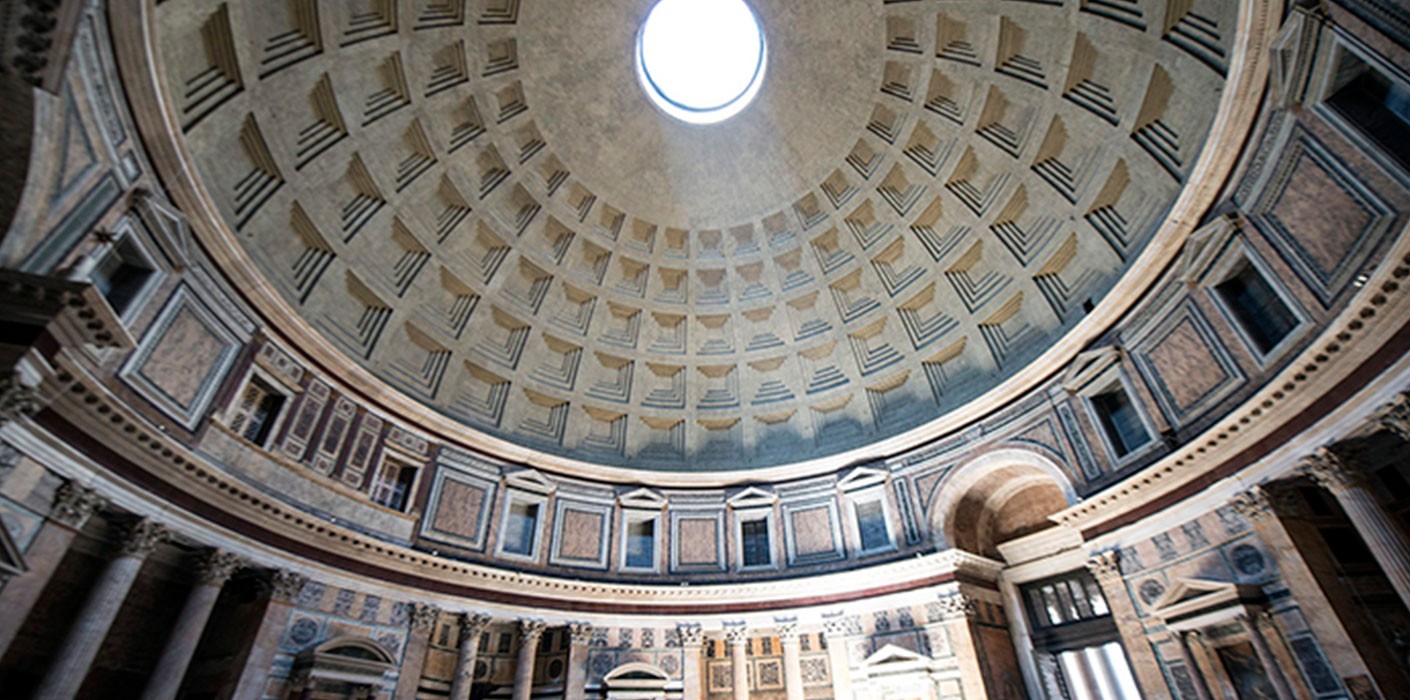
The dome that crowns it is still the largest unreinforced concrete dome ever built. Its stability relies on a series of technical decisions remarkably advanced for its time: walls up to five meters thick at the base; concrete that becomes progressively lighter as it rises—thanks to volcanic pozzolana; a system of hidden relieving arches within the brick structure; and coffers that, far from being decorative, significantly reduce the overall weight. The thickness of the dome tapers to just one meter at its apex. At its center, a nine-meter-wide circular opening paradoxically closes the building without enclosing it. The oculus is not a poetic gesture, but a structural necessity: without it, the dome would not stand. It is said that Brunelleschi, centuries later, admitted he could not understand why the Pantheon did not collapse. What he did not realize is that it is precisely this void that prevents it from doing so.
Yet the oculus is far more than a technical solution. It is the perfect window—the one that looks directly toward the divine. The eye of time. Through it, light enters as a material in its own right: marking the passage of hours, days, and seasons. Snowflakes drift slowly within; on Pentecost, red rose petals float down with an almost weightless gravity from 43 meters above. Each April 21st, the anniversary of Rome’s founding, a beam of light pierces the space at noon and strikes the temple’s entrance. When one crosses the colonnade and steps inside, understanding comes instantly—not through reason, but through the body. A direct impact between the deepest part of the mind and the gut. One realizes that what holds the Pantheon is not only concrete or brick, but a pillar of light—a beam of photons that seems to support one hundred thousand tons for two thousand years.
It is said that the sculptor and architect Eduardo Chillida once stood silently near the center of the Pantheon, arms outstretched, as if embracing an invisible cylinder. He claimed to feel, with his cheek and fingertips, the change in density of a column that could not be seen: a column made of space, rising from the ground, passing through the oculus, and extending far beyond the sky. A column of light that still holds what may be the greatest building in the world. Nothing in the Pantheon is arbitrary. Every proportion, every material, every void responds to a precise logic. Light does not illuminate—it reveals. Space does not impress—it envelops. Two thousand years later, the building continues to fulfill its function—not as an archaeological ruin, but as a living place, used, transformed, and profoundly relevant. A silent reminder that true architectural greatness does not lie in the ephemeral, but in what endures.
II. Sustainability as Permanence
At Concretable, we understand sustainability in a way similar to that embodied by the Pantheon. We do not believe something is sustainable merely because of its natural appearance, reduced resource use, or alignment with contemporary trends. For us, true sustainability is proven over time. The Pantheon’s concrete was not conceived as a “green” material in today’s sense. Yet its ability to withstand centuries of use, cultural transformation, and climatic change makes it one of the clearest examples of real sustainability. What endures avoids replacement. What remains relevant does not need to be produced again. In an age defined by rapid obsolescence, the Pantheon invites us to rethink how we design and build today. It reminds us that sustainability is also a matter of cultural responsibility: creating objects, spaces, and materials capable of accompanying generations, adapting over time, and continuing to hold meaning. It is within this idea of conscious permanence that Concretable finds one of its main sources of inspiration. To design in concrete not as an immediate gesture, but as a commitment to durability, material honesty, and the trace we leave in the spaces we inhabit.